
10 Best Trello Alternatives for Teams
Atlassian shipped a redesigned Trello on May 22, 2025, and a lot of long-time users didn’t like what they got. On r/trello and the Atlassian Community forum, people who had run team boards for years said the new card layout slowed them down and asked how to get the old one back. Several threads called it the worst update they had ever sat through. That reaction is why so many teams started looking for Trello alternatives.
Atlassian’s response made the direction clear. A company spokesperson said Trello’s future is about helping individuals manage their work and life, and pointed teams that need fuller project management to Jira. Shared boards still work, but new features now go to personal planning, and the Free plan still stops at 10 boards and 10 collaborators per Workspace. The practical fix is to replace Trello by the job it stopped doing for your team.
This is where we’d start, depending on that job:
- Plaky for shared boards that stay free for unlimited users.
- ClickUp when tasks, docs and time tracking should live in one tool.
- Asana when deadlines depend on work from other teams.
- Linear when the board is really a software backlog.
- Microsoft Planner when the company already pays for Microsoft 365.
- Basecamp when client projects need one flat bill instead of per-user fees.
- WeKan or Planka when the data has to stay on your own server.
What Happened to Trello in 2025?
Before comparing tools, it helps to know exactly what changed, because some of it matters for teams and some of it doesn’t. The new Trello announcement and the coverage that followed give a clear picture:
- The new Trello became generally available on May 22, 2025 and rolled out to Free, Standard and Premium accounts through July.
- It added an Inbox for capturing to-dos from email, Slack and Microsoft Teams, a Planner that puts cards on your Google or Microsoft calendar and AI-assisted quick capture.
- The card back became more compact, and a new navigation bar switches between Inbox, Planner and boards.
- By August 2025, one Atlassian Community thread about the change had close to 200 posts, mostly complaints, according to The Register’s report.
- Atlassian’s statement in that report said new features and the interface would keep reflecting the shift toward individuals, and it recommended Jira for teams that want a more capable project tool.
Trello still runs shared boards, and Atlassian is now building it for one person’s day. If your board is shared by a few people who move cards and nothing more, the redesign is an annoyance you can live with. If you were waiting for better dependencies, reporting or team permissions, Atlassian has already told you those features live in a different product.
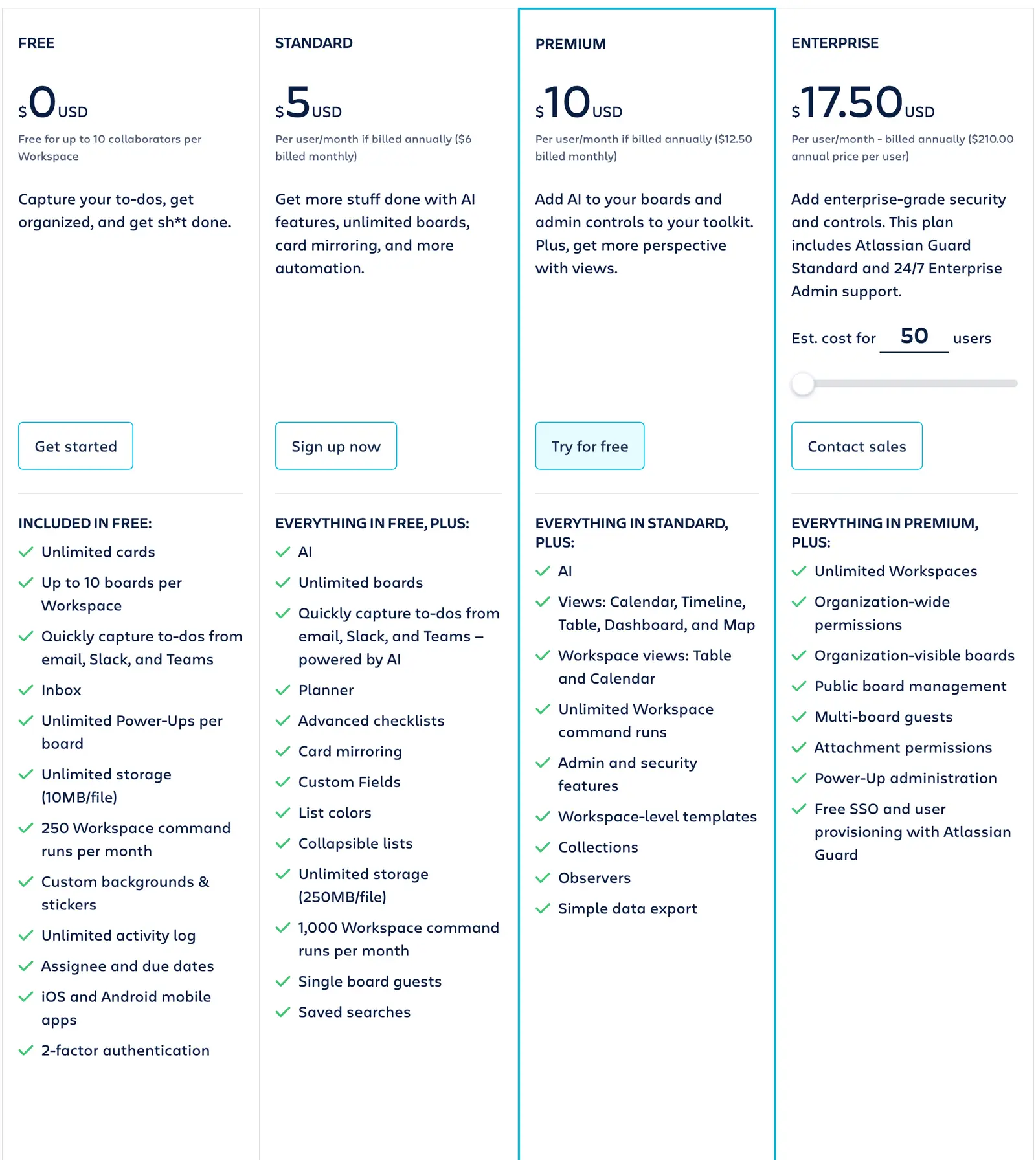
For reference, this is what each Trello plan includes today:
- Free: 10 boards per Workspace, 10 collaborators per Workspace, 250 Workspace command runs a month for automation, 10MB per file, the Inbox and a view-only Planner.
- Standard, $5 per user per month billed annually ($6 monthly): unlimited boards, the full Planner, AI features, custom fields, card mirroring and 1,000 command runs a month.
- Premium, $10 per user per month billed annually ($12.50 monthly): Calendar, Timeline, Table, Dashboard and Map views, unlimited command runs, admin controls and simple data export.
- Enterprise, $17.50 per user per month billed annually: organization-wide permissions, multi-board guests and SSO through Atlassian Guard.
The 10-collaborator cap applies to the whole Workspace, so a team of 11 hits it the day the eleventh person joins. Calendar view is a Premium feature, which means the cheapest Trello plan with a team calendar costs $10 per person.
Trello Alternatives Compared
Each tool below fixes a different Trello problem, so the useful comparison is the free-plan limit you’ll hit first, how the paid plan charges you and whether your boards can come across. Current prices sit in each tool’s section.
| Tool | Best fit | Free plan limit that matters | How paid plans charge | Trello import |
|---|---|---|---|---|
| Plaky | Shared boards on a budget | Unlimited users and boards; 6 fields per board, no automations | Per seat | CSV file |
| ClickUp | Tasks, docs and time tracking together | Unlimited members; 60MB storage in total | Per user, whole Workspace upgrades together | Native importer |
| Asana | Deadlines that depend on other teams | 2 users | Per user, free guests on paid plans | CSV or migration app |
| Linear | Software issues and product work | Unlimited members; 2 teams, 250 issues | Per user | None |
| Jira | Software and IT workflows | Up to 10 users | Per user, rate falls as seats rise | Native importer |
| Notion | Tasks beside documents | Limited blocks once 2+ members share | Per member | Native importer |
| monday work management | Operations boards with columns | 2 seats, 3 boards | Per seat, sold from 3 seats | Native, name, labels and dates only |
| Microsoft Planner | Teams already on Microsoft 365 | Basic Planner included in Microsoft 365 | Per user add-on plans | Third-party tools |
| Airtable | Records linked to other records | 1,000 records per base, 5 editors | Per paid seat | CSV file |
| Basecamp | Client projects at a flat price | 1 project, 5 users | Flat monthly price, capped by active projects | None |
If you’d rather start from the reason you’re leaving, this decision path routes each common complaint to the tool that fixes it.
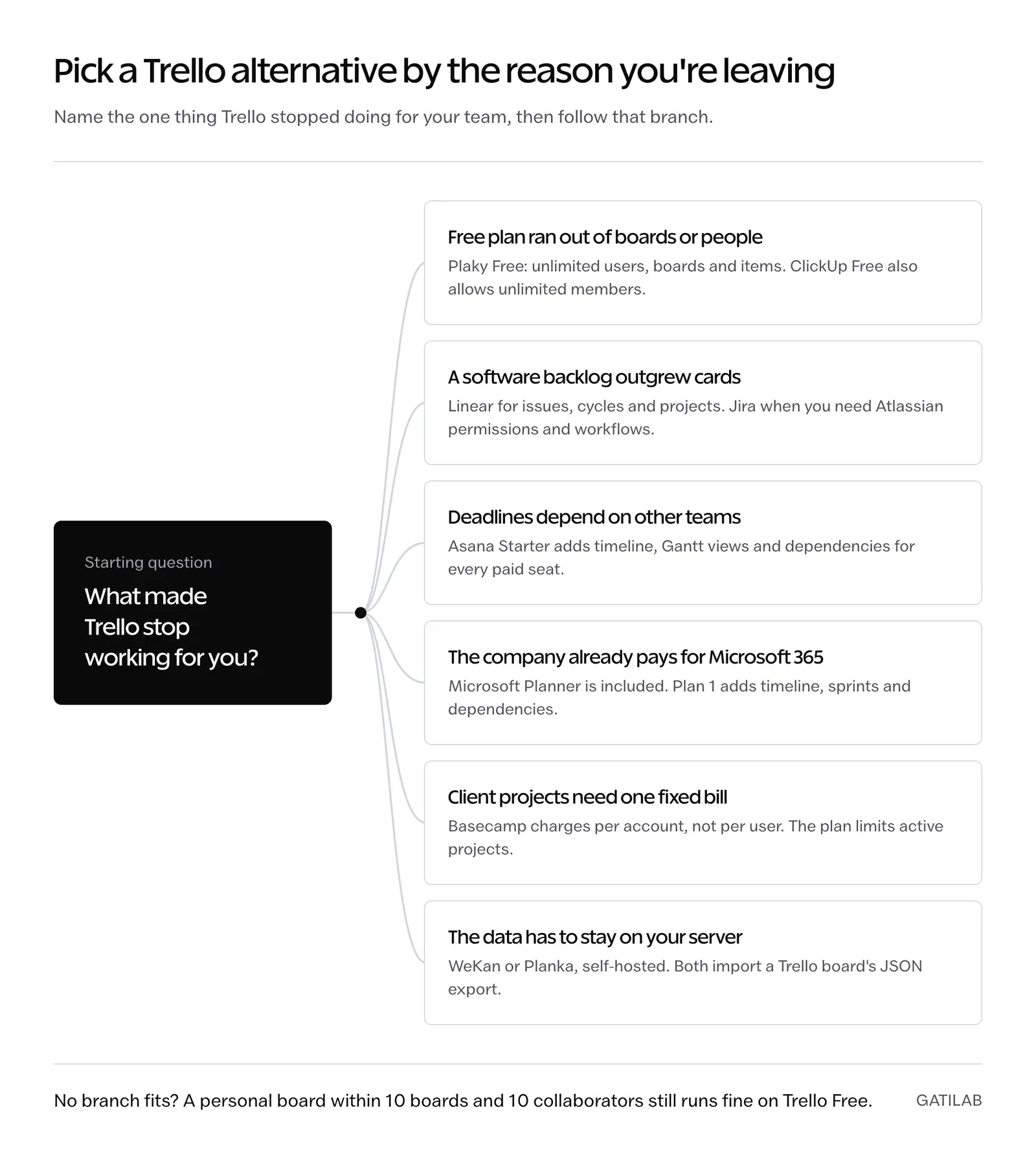
Best Trello Alternatives
These 10 tools cover the jobs Trello users most often leave for. Prices are list prices in US dollars before tax, and annual figures are the monthly equivalent of a yearly plan.
Plaky
Plaky is the closest like-for-like replacement for a team that simply wants shared boards without a seat cap. It’s made by CAKE.com, the company behind Clockify time tracking and Pumble chat, and its free plan has no user limit at all.
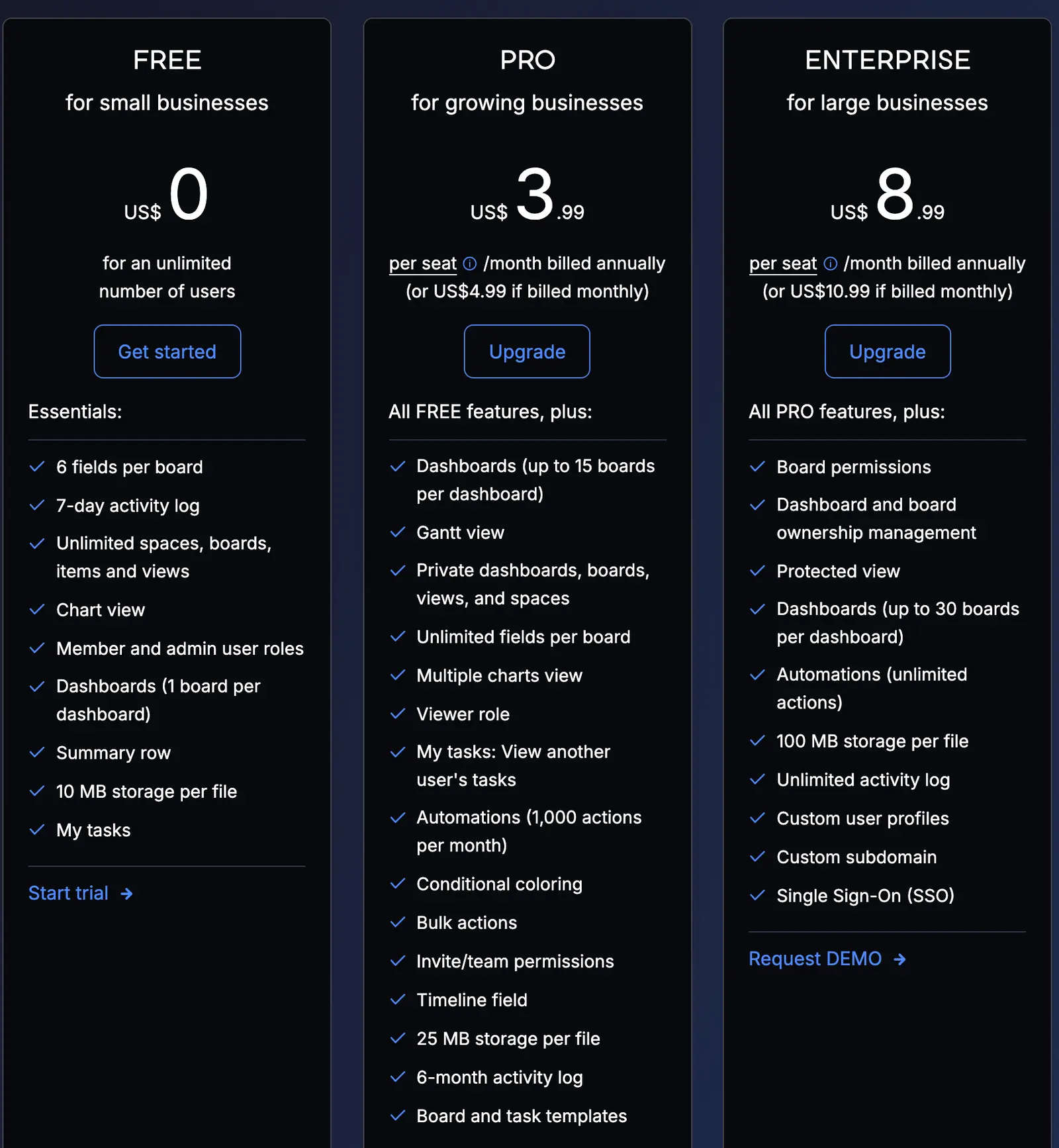
- Free: unlimited users, spaces, boards, items and views, with Table, Kanban and Chart views, 6 fields per board, a 7-day activity log and 10MB per file.
- Pro, $3.99 per seat per month billed annually ($4.99 monthly): Gantt view, unlimited fields, private boards, a viewer role and 1,000 automation actions a month.
- Enterprise, $8.99 per seat per month billed annually ($10.99 monthly): board permissions, unlimited automation actions, SSO and a custom subdomain.
The free plan has no automations and only 6 fields per board, so a board that relies on Butler rules or lots of custom fields needs Pro from day one. Plaky imports boards from CSV, and Trello only exports CSV on Premium, so a Free or Standard Trello user needs an export Power-Up to bring boards across.
ClickUp
ClickUp suits a team that wants tasks, docs, chat and time tracking in one workspace instead of paying for four separate tools. It imports Trello boards natively and turns each board into a ClickUp Space.
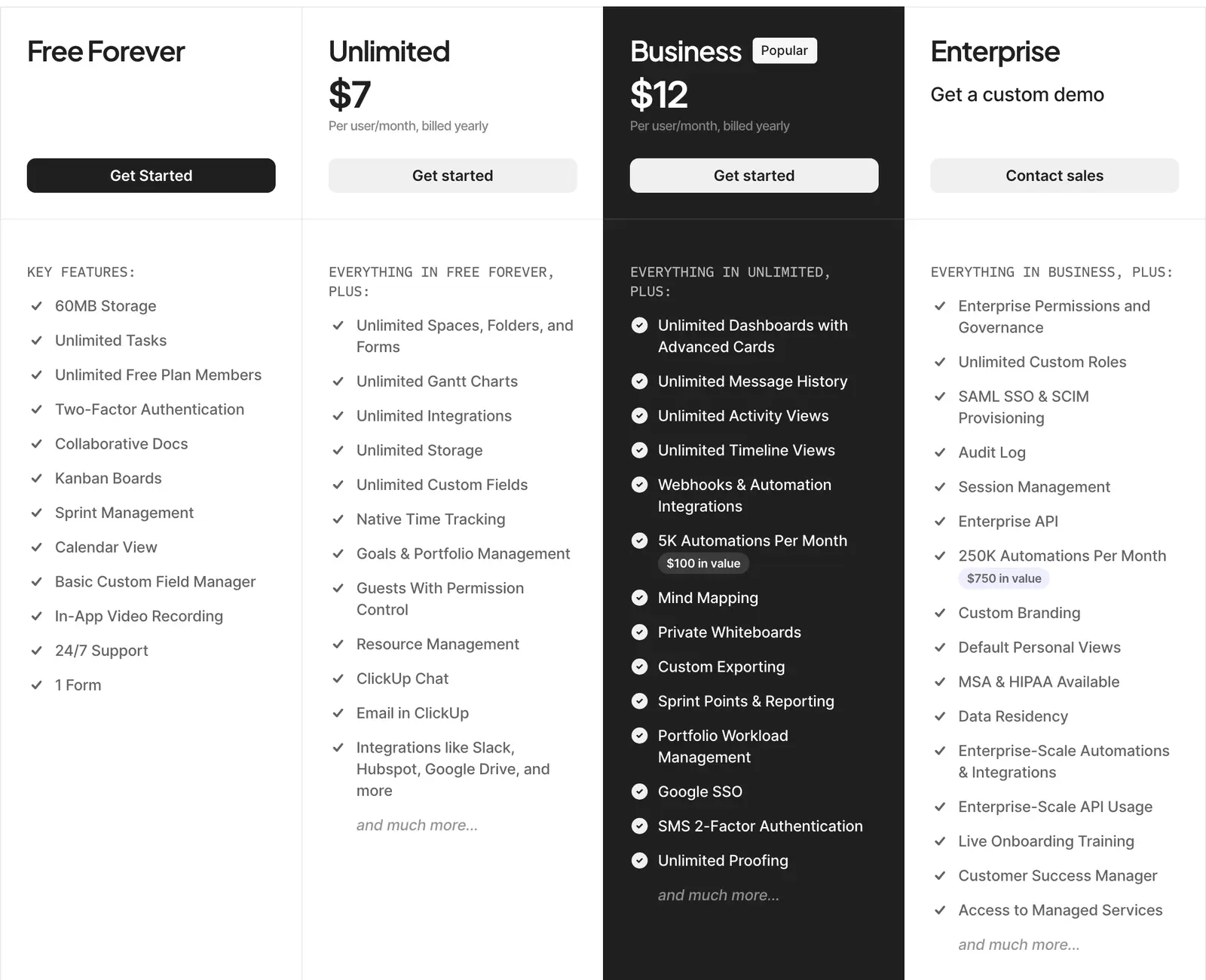
- Free Forever: unlimited tasks and members, Kanban and Calendar views, collaborative docs and sprints, with 60MB of storage in total.
- Unlimited, $7 per user per month billed yearly ($10 monthly): unlimited storage, Gantt charts, integrations, native time tracking and guests with permission controls.
- Business, $12 per user per month billed yearly ($19 monthly): unlimited dashboards and timeline views, 5,000 automations a month, Google SSO and custom exporting.
- AI add-ons: Brain AI is $9 per user per month and Everything AI is $28, on top of the plan.
60MB disappears after a handful of attachments, so Free should be treated as a trial for any team that shares files. ClickUp also upgrades the entire Workspace at once, which means you can’t pay for 3 heavy users and leave everyone else on Free. The bigger cost is setup time: Spaces, Folders and Lists give you many ways to organize the same work, and someone has to decide which one the team uses.
Asana
Asana is the one to compare first when deadlines depend on other people, such as a campaign that can’t launch until design and legal sign off. Its timeline and Gantt views show those dependencies in a way a Trello board never did.
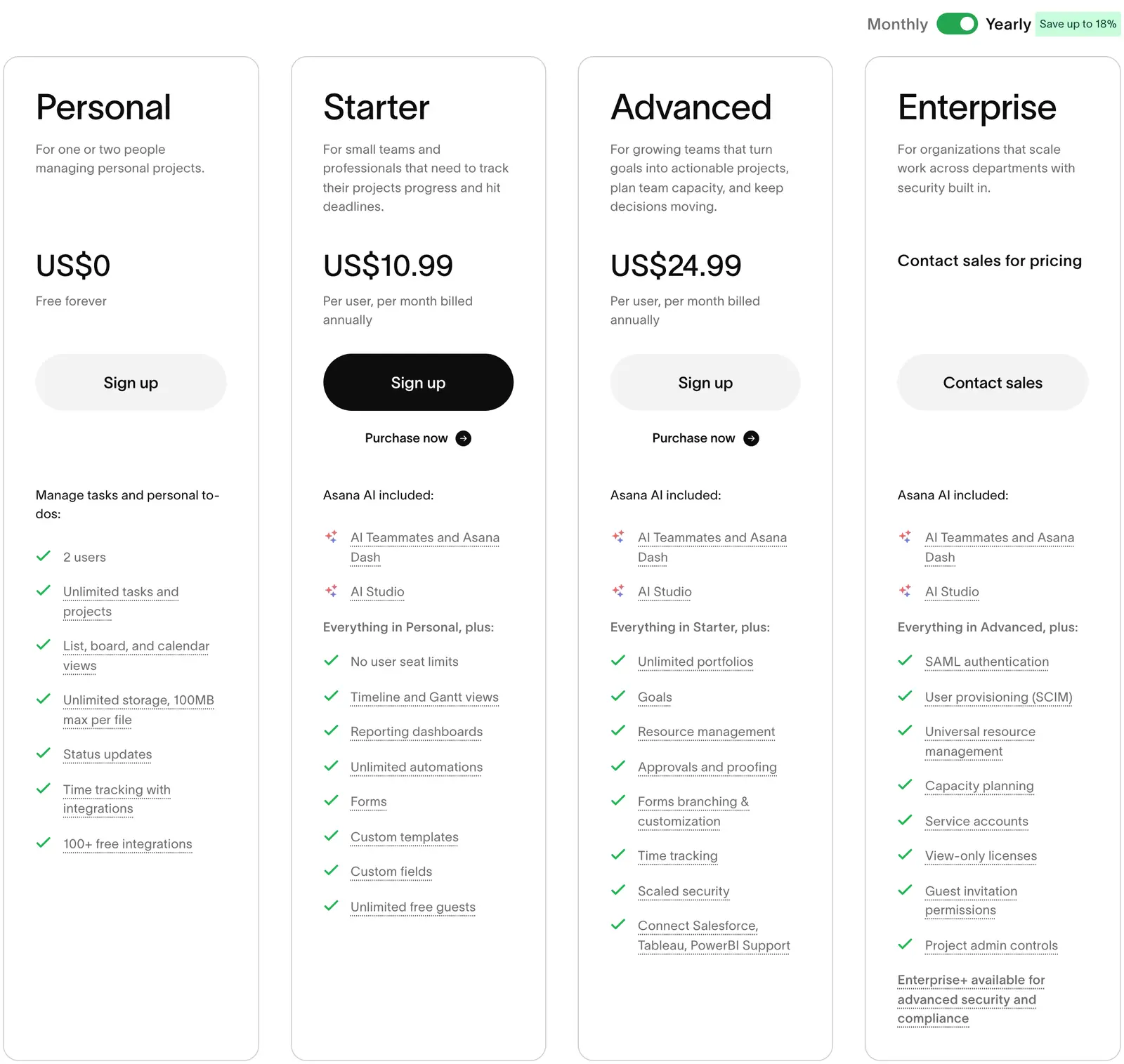
- Personal (free): 2 users, unlimited tasks and projects, 100MB per file and list, board and calendar views.
- Starter, $10.99 per user per month billed annually: no seat cap, timeline and Gantt views, reporting dashboards, unlimited automations, forms and unlimited free guests.
- Advanced, $24.99 per user per month billed annually: portfolios, goals, resource management, approvals and time tracking.
- AI: paid plans include AI Teammates and Asana Dash at 5 requests per user a month, with extra requests sold separately.
Personal tops out at 2 users, so Asana is a paid tool for any real team. Unlimited free guests on Starter help agencies, because clients and freelancers can work inside a project without adding seats. Asana’s documented routes for Trello data are a CSV import or the Migrator.xyz app in its integrations directory.
Linear
Linear is built for software teams whose Trello board slowly turned into a bug tracker. It organizes work into issues, cycles, projects and initiatives, which fits a product backlog far better than lists of cards.
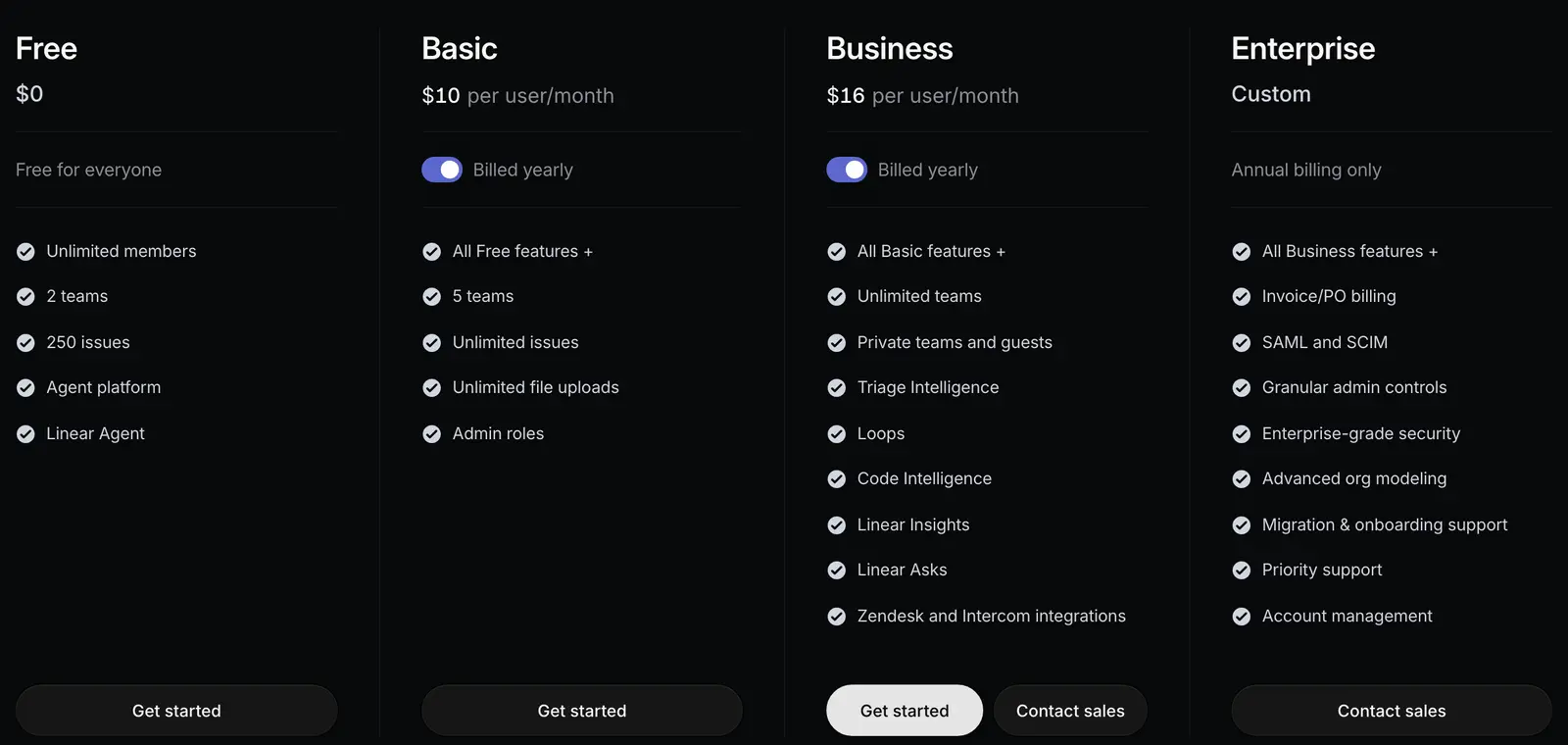
- Free: unlimited members, 2 teams, 250 issues and 10MB uploads.
- Basic, $10 per user per month billed yearly: 5 teams, admin roles and unlimited issues and uploads.
- Business, $16 per user per month billed yearly: unlimited teams, private teams and guests, Linear Insights, Linear Asks and support-tool integrations.
- Enterprise: custom pricing on annual billing, with SAML, SCIM and migration support.
An active software team can use up 250 issues quickly, so Free works best for evaluating Linear on one project. Linear also has no Trello importer; its import options cover Jira, GitHub Issues, Asana and Shortcut, plus a command-line tool. A marketing or operations board will feel out of place here.
Jira
Jira is Atlassian’s own answer for teams leaving Trello, and it fits software and IT teams that need configurable workflows, permissions and sprint reporting. It can import a Trello board directly into a new Jira space.
- Free: up to 10 users, backlog, list, board, timeline and calendar views, 150 automation steps a month and 2GB of storage.
- Standard: user roles and permissions, external collaboration, Rovo AI features, 400 automation steps per user a month and 250GB of storage. For a 10-user team it costs $9.05 per user per month on monthly billing, or $900 a year on annual billing.
- Premium: cross-team planning, dependency management, approval processes and unlimited storage, at $18.30 per user per month for 10 users on monthly billing.
Jira’s per-user rate falls as the seat count rises, so price your real team size in Atlassian’s calculator instead of copying one number from a review. Jira also gives you far more to configure than a Trello board, and a small team with a simple backlog should compare Linear first. You need to be an org admin to run the Trello import, and people are matched by email address. Archived cards, checklists and custom fields are handled differently depending on the space type, with checklists turning into sub-tasks in some cases.
Notion
Notion fits teams whose tasks need to sit beside the documents that explain them, such as an editorial calendar linked to briefs and research notes. A Trello board imports as a Notion database, with lists becoming groups and cards becoming database items.
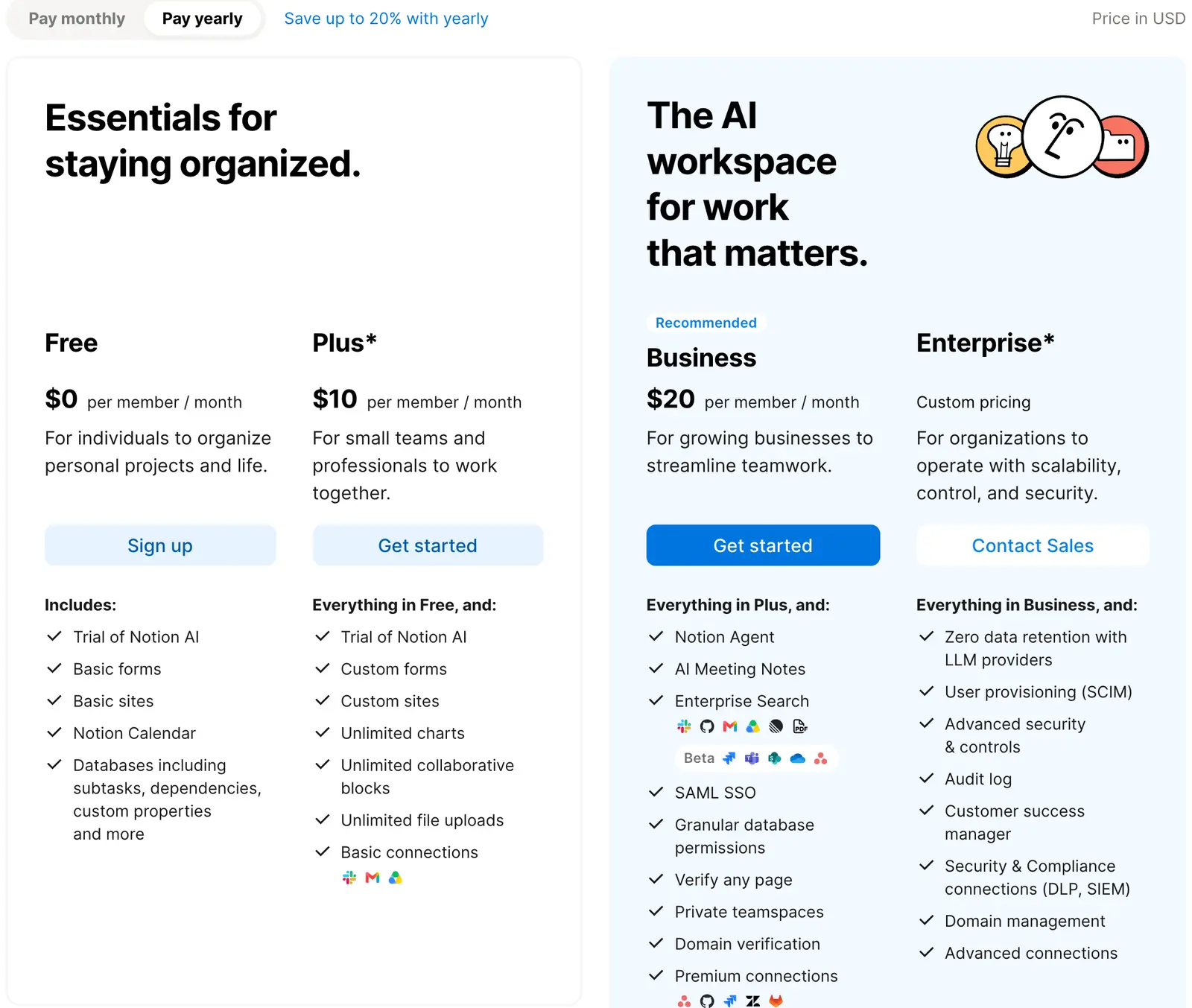
- Free: unlimited pages and blocks for one person, limited blocks once 2 or more members share a workspace, 5MB uploads, 7-day page history and up to 10 guests.
- Plus, $10 per member per month billed yearly: unlimited collaborative blocks and uploads, 30-day page history, custom forms and unlimited charts.
- Business, $20 per member per month billed yearly: Notion Agent, AI meeting notes, Enterprise Search, SAML SSO, private teamspaces and granular database permissions.
- Custom Agents: free to try, then $10 per 1,000 Notion credits a month.
Notion is a toolkit, so someone has to design the task database, its properties and the views people use. Without that work, a shared workspace drifts into several competing task lists. Our WordPress agency operations system covers the process side that a board alone won’t define.
monday work management
monday work management suits operations teams that already run their work in spreadsheets, because every board is a table of items with status, owner and date columns. It imports Trello boards from its Import data menu.
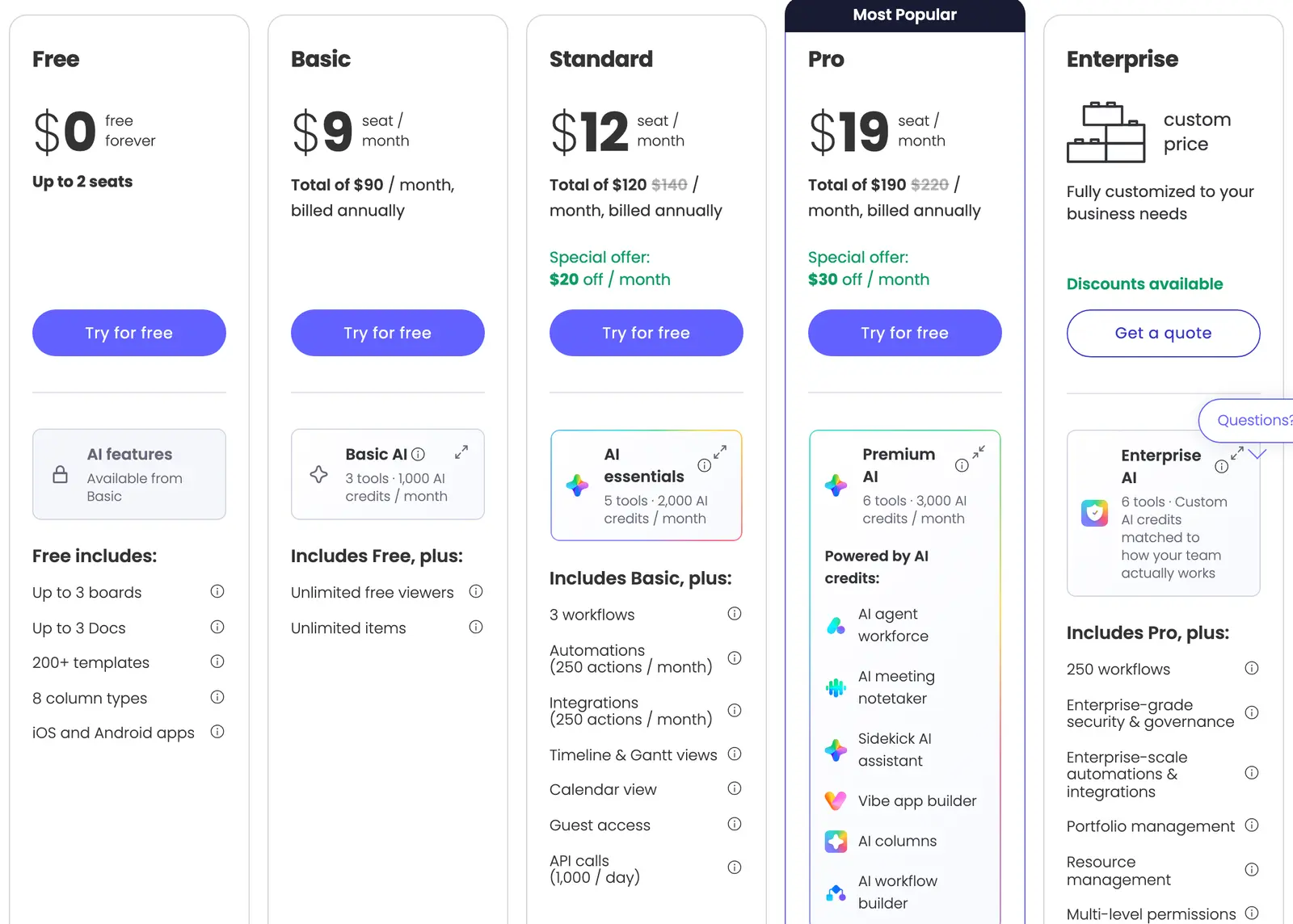
- Free: up to 2 seats, 3 boards and 3 docs, with 8 column types.
- Basic, $9 per seat per month billed annually: unlimited items and unlimited free viewers.
- Standard, $12 per seat per month billed annually: timeline, Gantt and calendar views, guest access and 250 automation and 250 integration actions a month.
- Pro, $19 per seat per month billed annually: private boards, time tracking and 25,000 automation and integration actions a month.
Paid plans are sold in seat buckets that start at 3, so a 2-person team still pays for 3 and a team of 11 buys the 15-seat bucket. The Trello importer carries the card name, labels and dates, while descriptions, checklists, activity and files stay behind. Basic has no automations, so the cheapest plan is rarely the fair comparison with Trello Standard.
Microsoft Planner
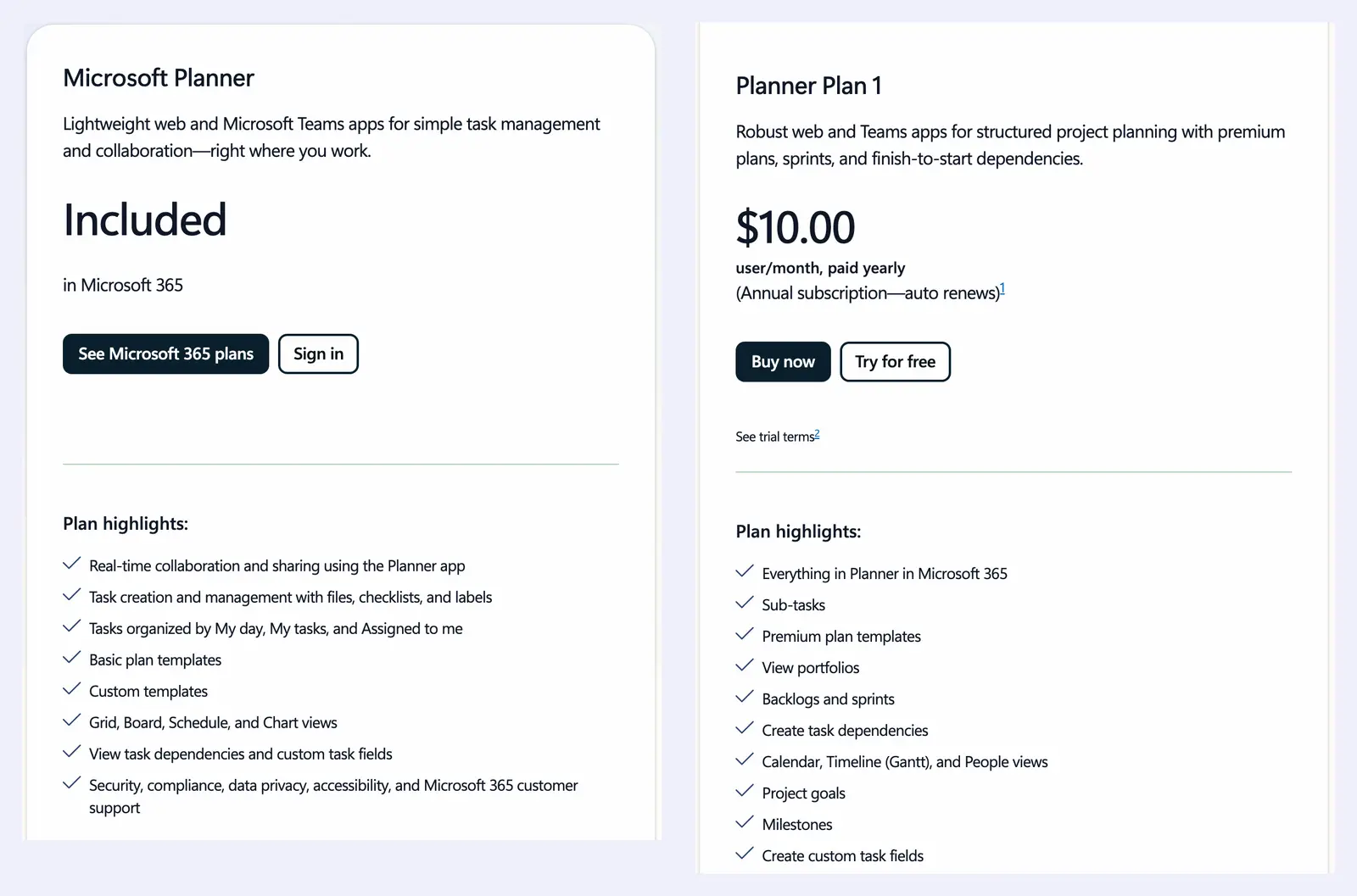
Microsoft Planner is the first thing to check if your company already pays for Microsoft 365, because the basic version is already included and runs inside Microsoft Teams. Its Board view is a Kanban board, which makes it the closest thing to a Microsoft version of Trello.
- Planner in Microsoft 365: included, with Grid, Board, Schedule and Chart views, checklists, labels, basic templates and a read-only view of task dependencies.
- Planner Plan 1, $10 per user per month paid yearly: sub-tasks, backlogs and sprints, creating task dependencies, Calendar, Timeline (Gantt) and People views, goals and milestones.
- Planner and Project Plan 3, $30 per user per month paid yearly: portfolios, baselines, critical path and the Project desktop app.
The included version is a light task board, and dependencies, sprints and a timeline need Plan 1 for each person who plans the work. Planner has no built-in Trello importer, so moving boards means a third-party migration tool or rebuilding them by hand.
Airtable
Airtable is the pick when a Trello card is really a record that links to other records, such as an article tied to a writer, an invoice and a set of assets. You can view it as a board, but the data underneath is a relational database.
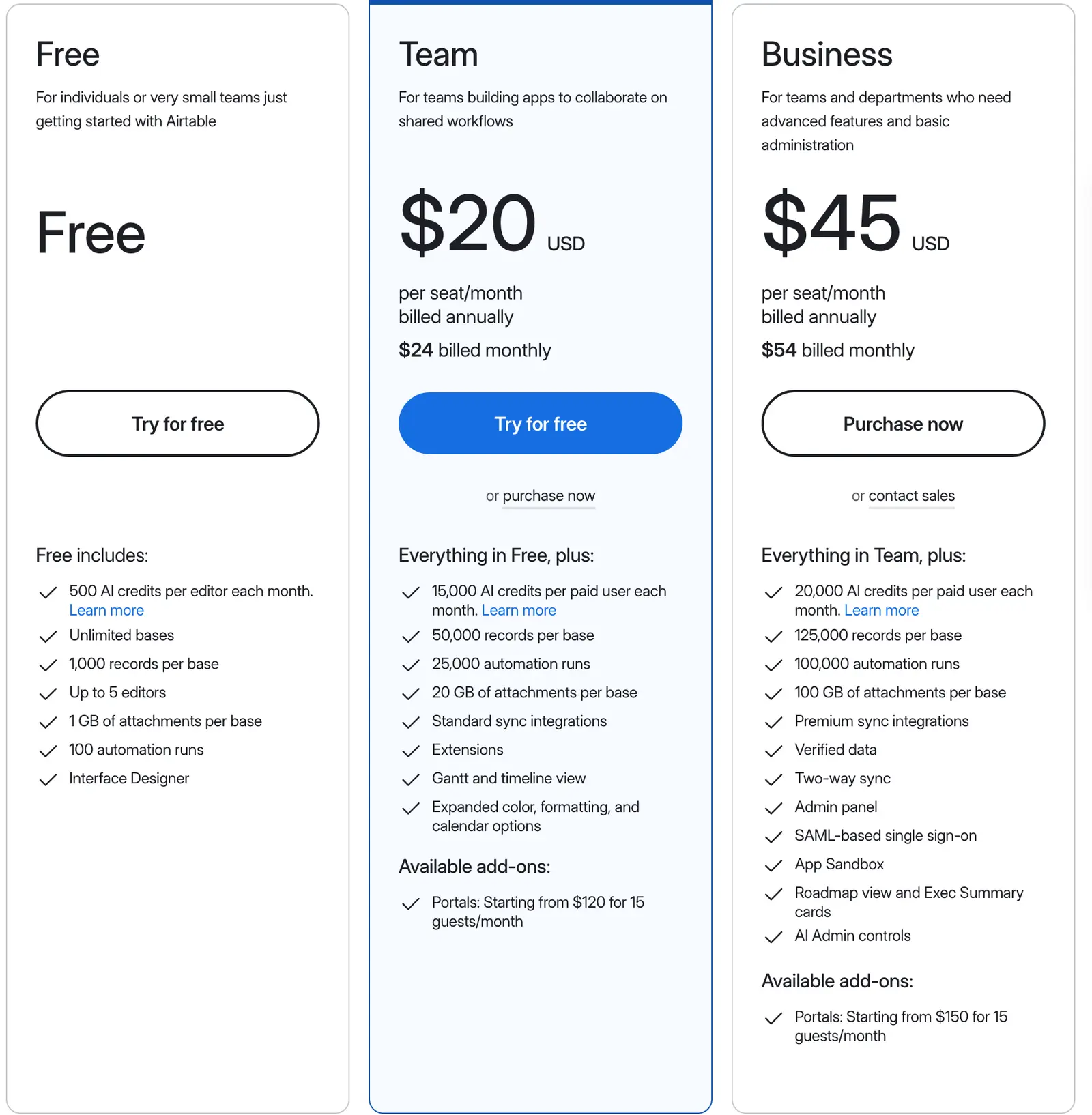
- Free: unlimited bases, 1,000 records per base, up to 5 editors, 1GB of attachments per base and 100 automation runs.
- Team, $20 per seat per month billed annually ($24 monthly): 50,000 records per base, 25,000 automation runs, 20GB of attachments per base and Gantt and timeline views.
- Business, $45 per seat per month billed annually ($54 monthly): 125,000 records per base, 100,000 automation runs, an admin panel and SAML single sign-on.
- AI credits: 500 per editor a month on Free, 15,000 per paid user on Team and 20,000 on Business.
Moving a Trello board into Airtable usually means a CSV import or a sync integration. For a client onboarding workflow, the linked records earn their keep. For a plain to-do board, the database setup and per-seat price add work you don’t need.
Basecamp
Basecamp suits agencies and client-service teams that want projects, messages, files and client access in one place for a fixed monthly bill. It does have a board: Card Tables is Basecamp’s Kanban tool, and it sits next to message boards, to-dos, schedules and group chat in every project.
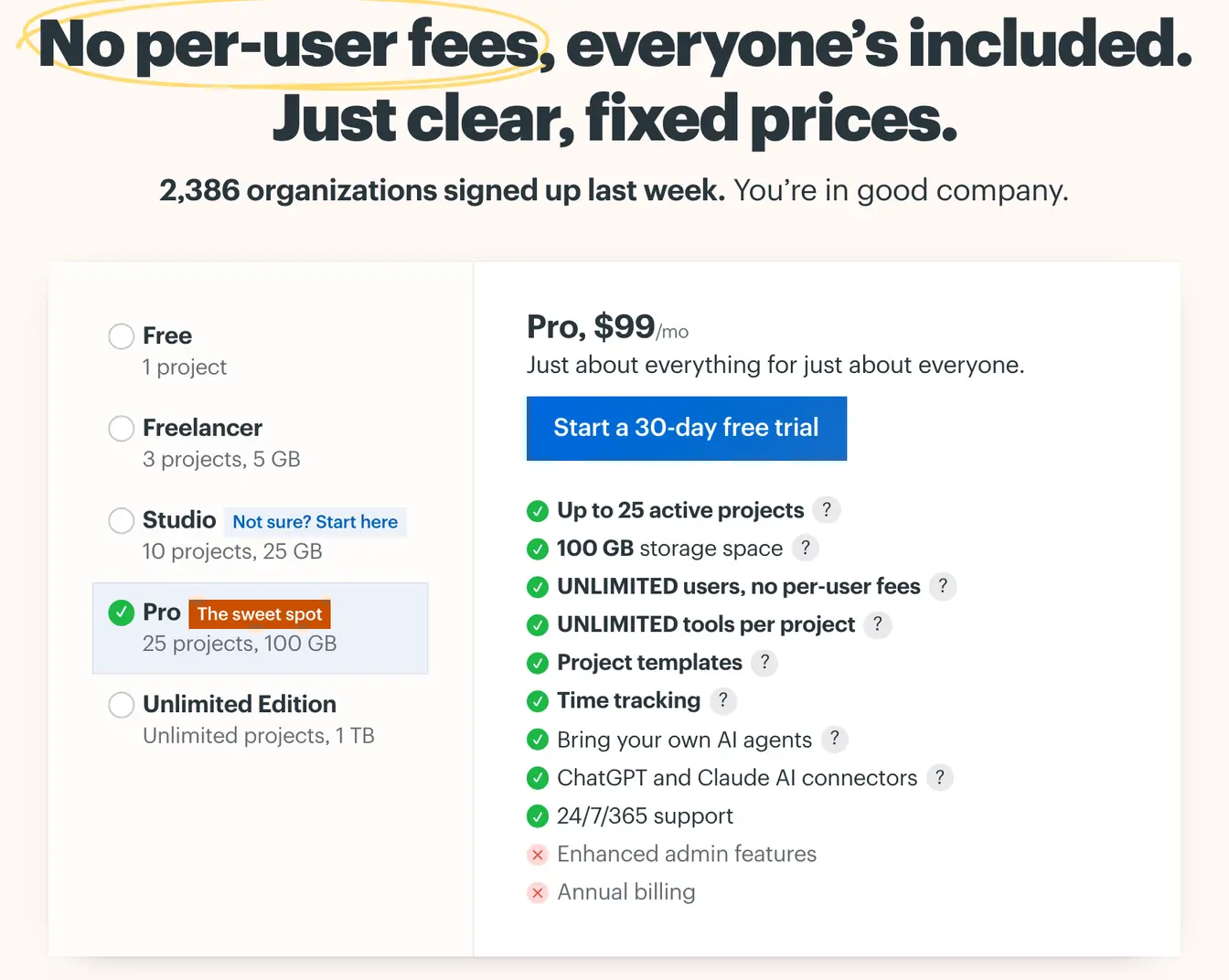
- Free: 1 project, 5 users and 1GB of storage.
- Freelancer, $25 a month: 3 active projects, up to 20 users and 5GB.
- Studio, $59 a month: 10 active projects, unlimited users and 25GB.
- Pro, $99 a month: 25 active projects, unlimited users, 100GB and time tracking.
- Unlimited, $299 a month billed annually: unlimited projects and users, 1TB and enhanced admin features.
Basecamp prices by active projects instead of people, so on the same plan a 30-person agency pays what a 5-person one does. The catch is the project cap: an agency running 12 live client projects needs Pro, although archived projects don’t count. There’s no Trello importer, so boards are rebuilt as Card Tables. If client access is the main problem, compare client portal software for agencies as well, and our notes on remote team communication practices show where Basecamp’s message-first style helps.
Free Trello Alternatives
Free plans differ in what they ration. Some cap people, some cap items and some cap storage, so the right free tool depends on which of those your team has the most of:
- Plaky: unlimited users, boards and items. The tight spots are 6 fields per board and no automations.
- ClickUp: unlimited members and tasks, with 60MB of storage for the whole Workspace.
- Linear: unlimited members, 2 teams and 250 issues.
- Jira: up to 10 users, with timeline and calendar views included.
- Trello: 10 boards and 10 collaborators per Workspace.
- Asana and monday work management: 2 users and 2 seats respectively, which makes both a trial for a team rather than a home.
For a team of more than 10 that wants to pay nothing, Plaky is the one to start with, because every other free plan here caps something a growing team runs into.
Open-Source and Self-Hosted Trello Alternatives
Self-hosting gives you control over where the data lives and removes per-seat fees. It also makes backups, upgrades and security patches your job, which is a real cost even when the software is free. These are the options worth a look:
- WeKan: an open-source Kanban board under the MIT license. It imports a Trello board’s JSON export, including lists, cards, labels and checklists.
- Planka: a self-hosted Kanban board with a free Community edition and paid Pro and Enterprise editions, also offered fully hosted. Its Trello import takes one board at a time from JSON, skips users and attachments and keeps one checklist per card.
- Plane: a project tool with cycles, modules and several layouts that you can use in Plane’s cloud or host yourself. The cloud Free plan covers up to 12 users.
- Focalboard: still popular in search, but its standalone repository is marked as not maintained, so it isn’t a safe pick for a new team.
If nobody on the team is comfortable running a server, a hosted free plan such as Plaky’s will cost less in practice than a free app that someone has to keep patched.
What a 10-Person Team Pays
For a quick budget check, this is the yearly cost of the first paid plan for 10 people on annual billing:
- Plaky Pro: about $479
- Trello Standard: $600
- Basecamp Studio: $708, with unlimited users ($59 a month)
- ClickUp Unlimited: $840
- Jira Standard: $900, although Jira Free already covers 10 users
- monday work management Basic: $1,080
- Linear Basic, Notion Plus and Planner Plan 1: $1,200 each
- Asana Starter: about $1,319
- Airtable Team: $2,400 if all 10 people are editors
The cheapest line is rarely the one that decides it. A team that needs timeline views and dependencies should compare Asana Starter with Trello Premium at $1,200 a year, rather than with the cheapest upgrade on this list.
How to Move Off Trello
A migration goes wrong when the team finds out after the switch that something didn’t come across. A one-board trial catches that before anyone commits:
- Export the board as JSON from the board menu under Print, export and share. Every Trello plan can do this, but the file holds only the board’s 1,000 most recent actions, so older comments can be missing.
- Move anything in your Inbox onto a board first. Trello can’t export Inbox cards.
- Use the CSV export or a full Workspace export only if you’re on Premium. The Workspace export is also the only route that bundles raw attachments in a ZIP file.
- Pick the import route your new tool supports: native importers in ClickUp, Jira, monday work management and Notion; CSV in Plaky, Asana and Airtable; JSON in WeKan and Planka.
- Import one representative board and check owners, due dates, checklists, descriptions and attachments against the original.
- Rebuild automations by hand. None of the importers above lists Butler rules among the things it carries over.
- Keep the Trello board untouched until the team has worked in the new tool for a full cycle.
Even a tool chosen in October 2026 deserves a 2-week trial on real work before anyone buys a year of seats. A demo board never shows you which field your team actually depends on.
When Trello Still Fits
Trello still makes sense for the people Atlassian is now building it for. A solo user who wants an Inbox, a calendar-based Planner and a few personal boards gets a well-made tool, and Standard at $5 per user is cheaper than every paid per-user plan in this list except Plaky Pro.
A small team that fits inside 10 boards and 10 collaborators, moves cards and needs nothing more can stay put too. Moving would cost a migration and retraining without fixing anything. The useful question for 2026 is which feature your team is missing, and whether Trello’s new direction will ever add it.
Whichever tool you choose, it only works as well as the process around it. Our guide to agency systems that scale covers that part, and managing several clients at once shows how the board fits into a client-heavy week.
FAQs on Trello Alternatives
What happened to Trello?
Atlassian released a redesigned Trello on May 22, 2025, with an Inbox, a calendar-based Planner and AI quick capture. It later said the product’s future is helping individuals manage their work and life, and recommended Jira to teams that need fuller project management.
Does anyone still use Trello?
Yes. Individuals and small teams that fit inside the Free plan’s 10 boards and 10 collaborators per Workspace still use it, and Atlassian keeps adding personal planning features. The teams moving away are mostly the ones that need dependencies, reporting or team permissions.
Is there a Google equivalent of Trello?
Google doesn’t make a team Kanban board. Google Tasks covers personal to-do lists, so Google Workspace teams usually pick a board tool that connects to Google Drive and Calendar, such as Asana or ClickUp.
Is there a Microsoft equivalent of Trello?
Microsoft Planner. Its Board view works like a Trello board, the basic version is included in Microsoft 365, and Planner Plan 1 at $10 per user per month paid yearly adds timelines, sprints and task dependencies.
What is the best free Trello alternative with unlimited users?
Plaky’s Free plan allows unlimited users, boards and items, with limits on fields and no automations. ClickUp Free also allows unlimited members but caps storage at 60MB for the whole Workspace.
Which Trello alternatives import Trello boards directly?
ClickUp, Jira, monday work management and Notion have native Trello importers. Plaky, Asana and Airtable take CSV files, and the self-hosted WeKan and Planka import Trello’s JSON export.
Is Asana or Trello better for a small team?
Trello is cheaper and simpler for a board-only workflow. Asana is the better fit when tasks depend on each other and deadlines matter, but its free plan allows only 2 users, so a team pays from Starter at $10.99 per user per month billed annually.
Should I use Trello or Todoist for personal tasks?
Todoist suits task lists with reminders and recurring due dates, and its free plan includes 5 personal projects with list and board layouts. Trello suits people who plan visually on boards, and its Inbox and Planner now cover personal planning too.
Tell Google you want more of this.
Add Gatilab as a preferred sourceOne tap, and this site shows up more often in your own Top Stories, AI Overviews and AI Mode. Remove it any time.