
Audience Building Before Product Launch: A Pre-Launch Framework
Most founders build something, then look for people to buy it. This is backwards.
The smarter approach: gather an audience first, then figure out what to sell them.
I’ve done it both ways. Building audience first is harder emotionally but easier practically. My content business took 18 months before I launched a paid offering. But when I did launch, I had buyers on day one. Compare that to a product I built in isolation… crickets for months. The order matters more than most founders realize.
Here’s the framework I now use and recommend.
The Traditional Approach Problem
The standard startup path goes: idea, product, launch, marketing.
What typically happens:
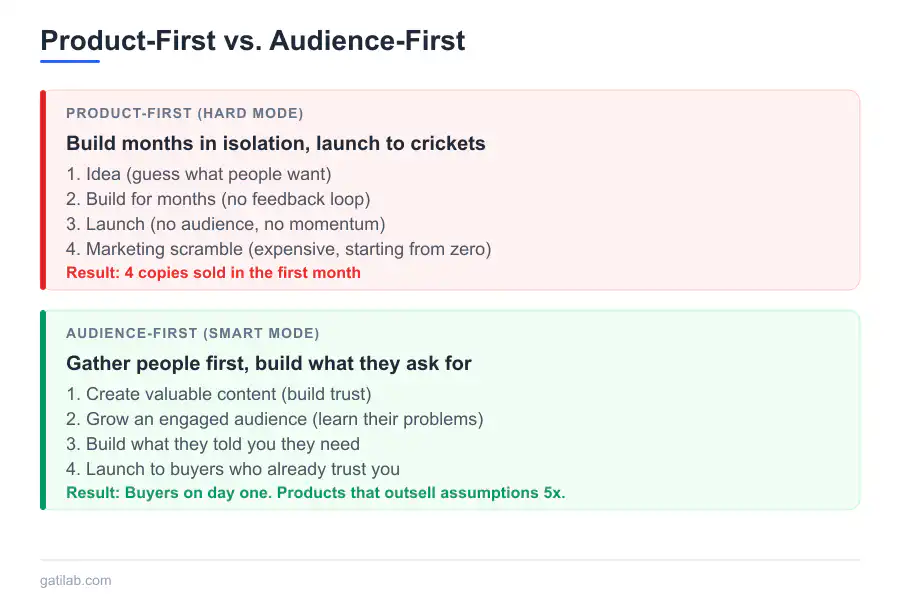
You spend months building. You launch to crickets. You realize you have a product but no customers. Now you need to learn marketing while also running a business. I watched a friend spend eight months building a WordPress plugin, launch it with zero audience, and sell exactly four copies in the first month. Four.
This is hard mode.
Why it fails:
Building without an audience means guessing what people want. Even with customer research, you’re still predicting behavior. Predictions are often wrong. I’ve been wrong about what people would pay for more times than I’d like to admit.
When you launch to nobody, you get no feedback. No early adopters. No momentum. Just silence and doubt.
The marketing scramble:
Post-launch marketing is expensive and slow. You’re starting from zero while competing against established players with existing audiences.
Customer acquisition costs are highest when you have no organic reach. You’re paying full price for every eyeball. I’ve seen founders spend more on marketing in the first month than they spent building the product. That’s a broken model.
The Audience-First Advantage
An audience tells you what to build. A product hopes people will come. The difference isn’t philosophical. It’s financial. Products built from audience feedback outsell assumption-based products by 5x in my experience.
Building audience before product inverts these problems.
Validated demand:
An audience tells you what they need. They ask questions. They share problems. They reveal opportunities. You don’t guess what to build. You learn what to build. My readers literally told me what they wanted to pay for. I just had to listen.
Built-in customers:
Launch day isn’t cold outreach. It’s an announcement to people who already know and trust you. Early sales come from existing relationships.
The hardest part of launching, getting initial traction, is already solved.
Distribution advantage:
Every piece of content, every email, every social post reaches people who chose to follow you. This compounds over time.
While competitors pay for each impression, you’ve built an owned channel that costs nothing to reach. That’s an unfair advantage. And it’s legal.
Lower risk:
You can validate ideas before building. Float concepts. Gauge interest. Iterate on positioning. All before writing code or creating products.
If an idea doesn’t resonate, you’ve lost a tweet, not a year of development.
The Framework
Building audience before product requires deliberate structure.
Phase 1: Define Your Territory
Pick a topic area:
Not a product category. A topic you can create content about for years. Something you know deeply or are passionate about learning publicly.
The topic should be specific enough to attract a defined audience but broad enough for years of content. WordPress development and freelancing was my territory. Broad enough for infinite content, specific enough that the right people find me.
Identify the audience:
Who cares about this topic? What are their characteristics? Where do they spend time online? What other topics interest them?
Be specific. “Small business owners” is too broad. “Solo consultants transitioning from agency work” is better. The more specific you are, the easier everything else becomes.
Choose your angle:
What perspective do you bring? Why should people follow you specifically? What unique experience, insight, or approach differentiates your content?
The angle prevents commodity content. It gives people a reason to choose you over everyone else writing about the same topic.
Phase 2: Establish Presence
Select primary platform:
Twitter, LinkedIn, YouTube, a blog, a newsletter. Pick one as primary. Focus there until you’ve built momentum. If you choose blogging, our guide on how to start a blog covers the fundamentals.
Spreading across platforms dilutes effort. Depth on one platform beats shallow presence on many. I made this mistake early, trying to be everywhere at once. I grew faster when I focused.
Create consistently:
Content builds trust over time. Sporadic posting builds nothing. Commit to a publishing schedule you can maintain indefinitely.
Frequency matters less than consistency. Weekly is fine if it’s actually weekly. I’ve been publishing twice a week for over sixteen years. That consistency built my entire audience.
Engage actively:
Audience building isn’t broadcasting. It’s participating. Reply to others. Join conversations. Add value before asking for attention.
The people who engage with your content become your first audience members. Treat them accordingly.
Phase 3: Build the List
Move people to owned channels:
Social platforms can change algorithms, ban accounts, or decline. Email lists and community memberships you control. Building an email list through strategic email marketing is one of the most valuable assets you can create.
Getting people off platforms and onto your email list is critical. Platforms are discovery; email is retention. I learned this the hard way when an algorithm change cut my social reach by 60% overnight. My email list didn’t flinch.
Provide ongoing value:
Newsletter subscribers expect something. Free resources, insights, early access, community connection. Give them reasons to stay.
List size matters less than list engagement. 1,000 engaged subscribers beats 10,000 dormant ones. I’d rather have a small list that opens every email than a massive list that ignores me.
Segment by interest:
As your audience grows, understand subgroups. Some care about topic A, others about topic B. This information guides product decisions later.
Phase 4: Listen and Learn
Track questions:
What do people ask you? What problems surface repeatedly? What frustrations appear in comments and replies?
Questions reveal gaps. Gaps reveal opportunities. I keep a running document of every question readers ask me. After six months, the patterns are obvious.
Note requests:
When people ask “do you offer X?” or “can you recommend Y?” pay attention. These are product opportunities with pre-validated demand.
Keep a running list. Patterns emerge over time.
Validate concepts:
Before building, share ideas. “I’m thinking about creating X. Would that be useful?” The responses guide direction.
This isn’t asking permission. It’s gathering signal before investing resources.
Phase 5: Product Development
Build what they ask for:
The product should solve problems your audience already expressed. Not problems you think they should have.
This feels obvious but most founders still build from imagination, not observation. I’ve been guilty of this too. The products I built from audience feedback outsold the products I built from my own assumptions by a factor of five.
Start small:
First product should be simple. An ebook, a course module, a template, a small tool. Something you can create in weeks, not months.
Small products test the buying relationship. Will this audience actually pay? For what? At what price?
Iterate publicly:
Share the building process. Get feedback on features. Involve the audience in development.
This builds anticipation while also validating direction. When you launch, people feel ownership. They’ve been part of the journey.
Practical Examples
The consultant pattern:
Build audience by sharing professional insights. Establish expertise through content. When audience asks for help implementing ideas, offer consulting services. Managing these relationships becomes easier with good CRM software.
The content proves competence. The audience provides leads. This is exactly how I built my consulting practice.
The info product pattern:
Build audience around a learning topic. Document your own learning or share existing expertise. When patterns emerge about what people struggle with, create courses or guides addressing those struggles.
The audience defines the curriculum. You’re not guessing what to teach. You’re teaching what they’ve already asked to learn.
The software pattern:
Build audience in a niche. Understand their workflows deeply. When clear pain points emerge, build tools that solve them. Having the right project management tools helps coordinate development with audience feedback.
The audience becomes beta testers, then customers, then advocates.
The Time Investment
Audience building takes time before it generates returns. That’s the honest truth.
Realistic timeline:
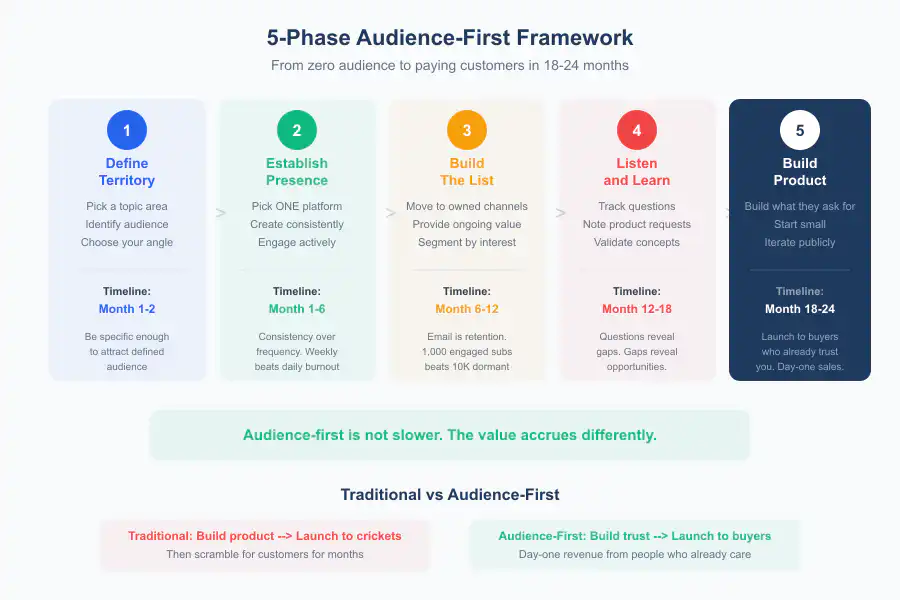
- Months 1-6: Establish presence, find voice, build initial following
- Months 6-12: Grow consistently, deepen engagement, start building email list
- Months 12-18: Understand audience deeply, identify opportunities, test ideas
- Months 18-24: Launch first product to receptive audience
Two years feels long. But compare to: build product for a year, launch to nobody, spend another year trying to find customers.
The audience-first path isn’t slower. The value accrues differently.
Compounding effects:
Early content continues working. Posts from year one still attract followers in year three. The email list grows even during slow periods.
This is different from paid acquisition where stopping spend stops growth. Organic audience growth has a flywheel effect that paid never will.
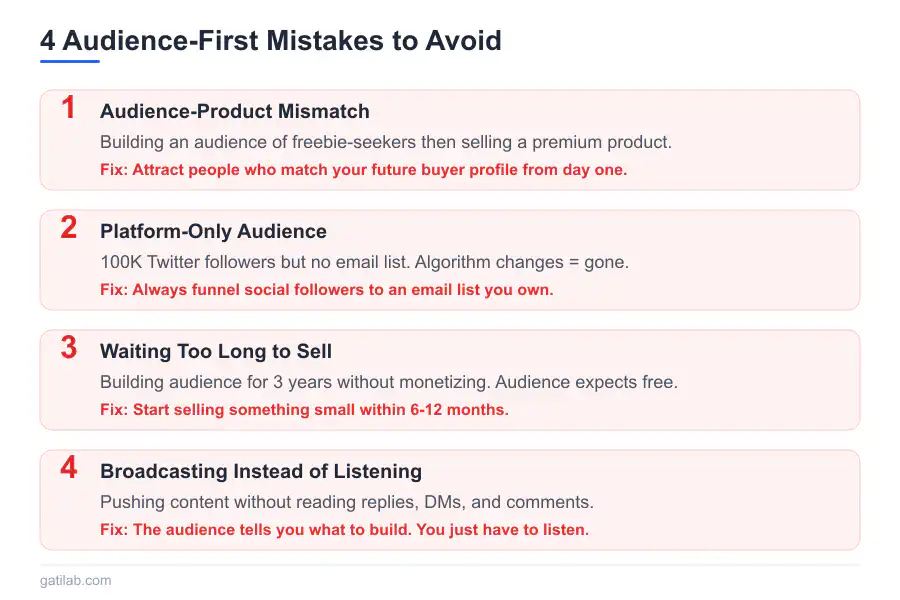
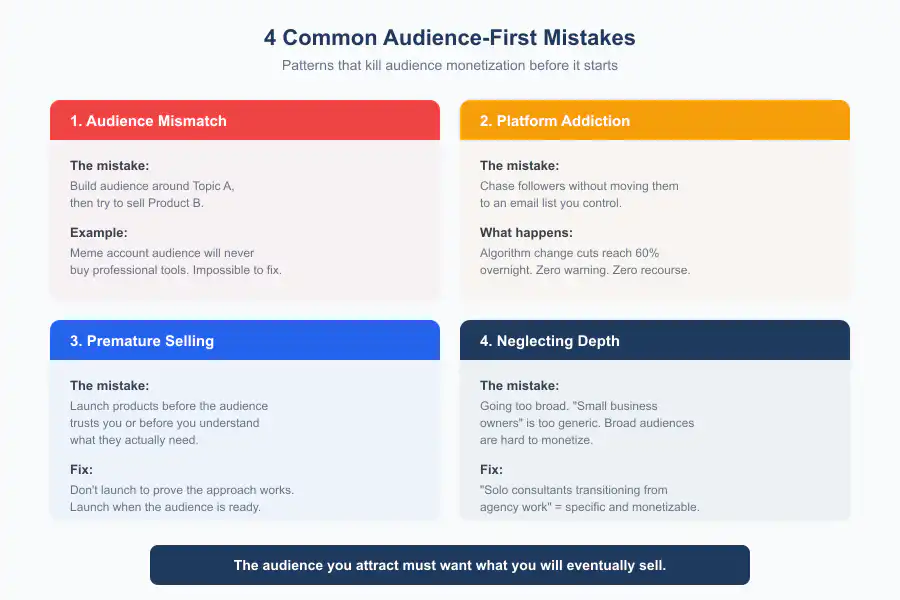
Common Mistakes
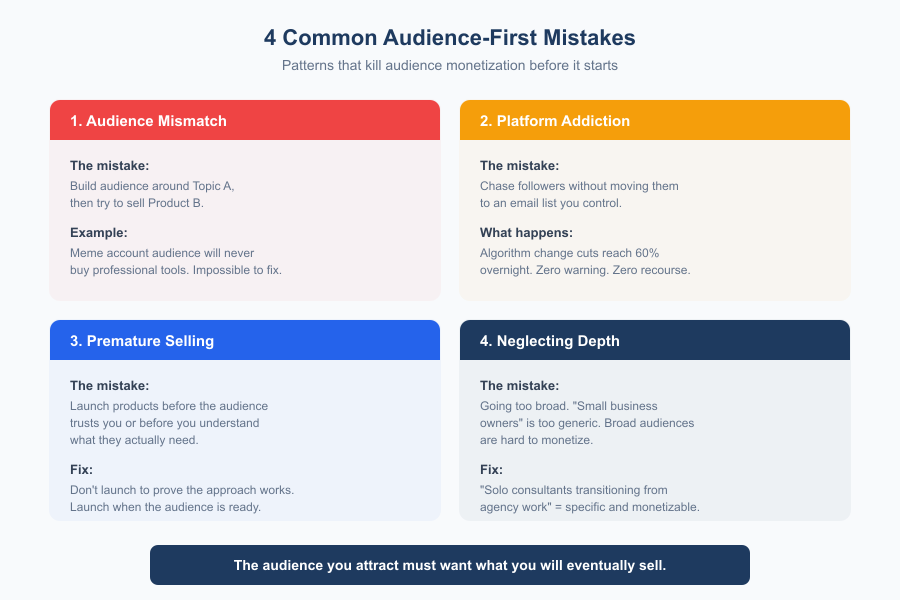
Audience mismatch:
Building an audience for topic A then trying to sell product B. The audience you attract must want what you’ll eventually sell.
A meme account audience won’t buy professional tools. Choose content strategy that attracts potential buyers. I see this mistake constantly and it’s almost impossible to fix after the fact.
Platform addiction:
Chasing followers without converting to email. Platforms are landlord territory. Build your own distribution.
Premature selling:
Launching products before the audience trusts you. Or before you understand what they actually need.
The timeline isn’t fixed, but patience is required. Don’t launch to prove the approach works. Launch when the audience is ready.
Neglecting depth:
Broad audiences are hard to monetize. Specific audiences buy specific products.
Go narrow enough that you can genuinely serve the audience’s needs, not just attract their attention.
The Minimum Viable Audience
You don’t need millions of followers. Most successful indie products launch to small, engaged audiences.
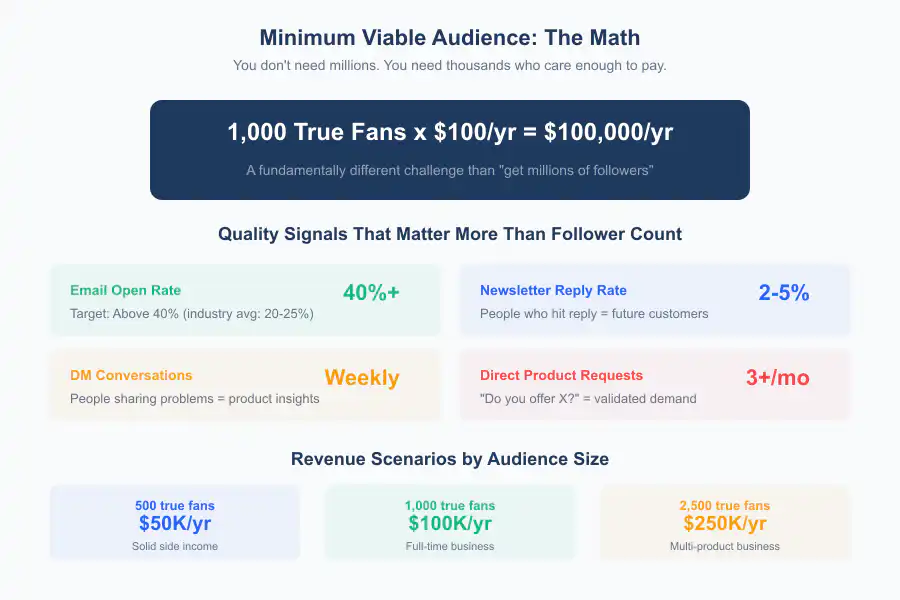
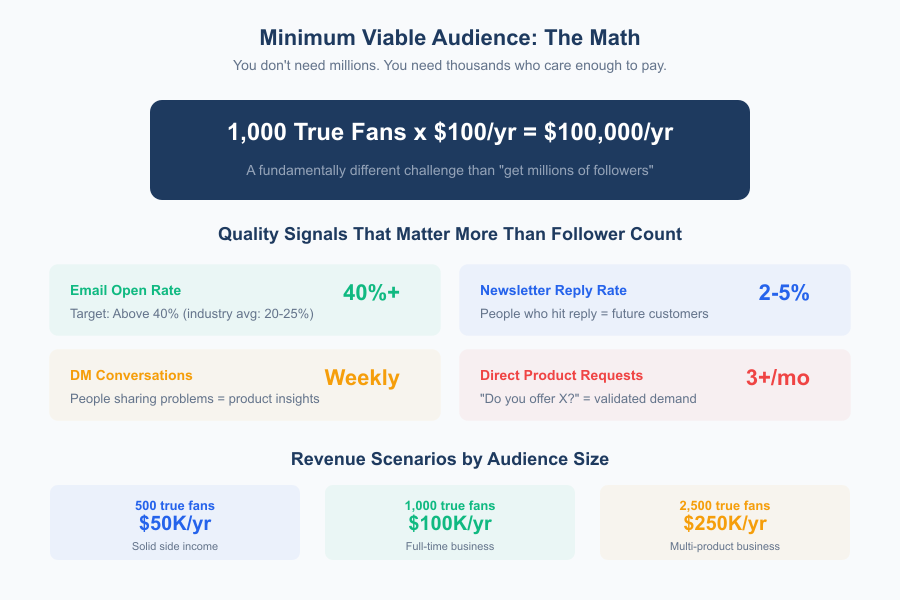
The math:
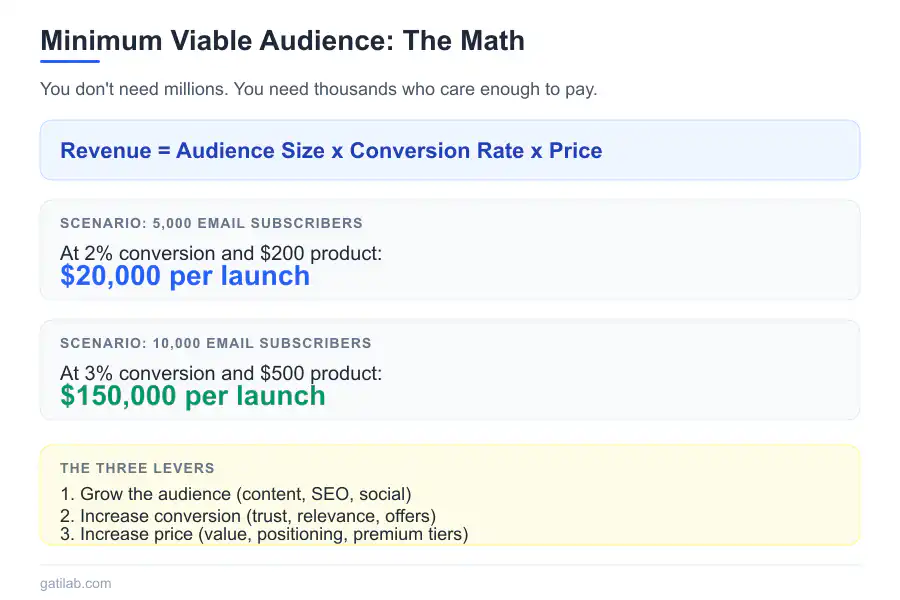
1,000 true fans at $100/year average = $100,000 annual revenue
You don’t need millions. You need thousands who care enough to pay. That’s a fundamentally different challenge.
Quality indicators:
- Email open rates above 40%
- Reply rate on newsletters
- DM conversations about problems
- Requests for products or services
These signals matter more than follower counts. A follower who never engages is a vanity metric. A subscriber who replies to your emails is a potential customer.
Transitioning From Existing Business
What if you already have a product or service?
Layer audience building:
Start creating content parallel to existing business. The content attracts future customers while current business sustains you.
Leverage existing customers:
Current customers are your first audience. What content would they value? What would they share with peers?
Document the journey:
Building in public attracts others on similar journeys. Your experience becomes content.
The Emotional Difficulty
Audience building feels slower than product building. Let’s be honest about that.
No tangible output:
Code, products, features feel like progress. Tweets and emails feel ephemeral. The work is real but doesn’t show in the same way. I’ve had days where I published three pieces of content and felt like I accomplished nothing. That feeling is misleading.
Uncertain returns:
Product value is quantifiable. Audience value is speculative until you monetize. This uncertainty is uncomfortable.
Exposure anxiety:
Putting yourself out there invites judgment. Imposter syndrome surfaces. The vulnerability is real.
These feelings are normal. The approach is still correct.
Long-Term Thinking
Audience is an asset that appreciates.
Compounding trust:
Each valuable interaction builds trust. Trust compounds. Five years of consistent value creates relationships that would take forever to build through advertising.
Multiple products:
An audience can support many products over time. First product might be small. Fifth product can be significant. My audience now supports multiple revenue streams that I couldn’t have imagined when I started publishing.
Resilience:
Business models change. Products fail. Platforms decline. An engaged audience persists. You can pivot, restart, or redirect because the relationship remains.
My content business took 18 months before I launched a paid offering. But when I did launch, I had buyers on day one. Every product I’ve built from audience feedback outsold the products I built from my own assumptions by a factor of five. The order matters more than the speed.
Build the audience first. Then build the products. The order matters more than most founders realize. For tools that help manage your growing business, check out our list of must-have tools for freelancers.
Audience Building Before Product Building FAQ
Frequently Asked Questions
Why should I build an audience before building a product?
Building audience first gives you validated demand since people tell you what they need, built-in customers for launch day, free distribution through owned channels, and lower risk because you can test ideas before building. Products built from audience feedback outsell assumption-based products by roughly 5x. The hardest startup problem, getting initial traction, is already solved when you launch to people who know and trust you.
How long does it take to build an audience before launching a product?
Realistically 18 to 24 months. Months 1-6 are for establishing presence and finding your voice. Months 6-12 focus on consistent growth and building your email list. Months 12-18 involve understanding your audience deeply and identifying opportunities. Months 18-24 are for launching your first product to a receptive audience. This is not slower than building a product and then scrambling to find customers. The value accrues differently and content keeps working over time.
How big does my audience need to be before I launch a product?
Smaller than you think. 1,000 true fans at $100 per year average equals $100,000 in annual revenue. Quality matters more than quantity. Focus on engagement signals: email open rates above 40%, reply rates on newsletters, DM conversations about problems, and direct requests for products or services. A subscriber who replies to your emails is far more valuable than 100 passive followers.
What are the biggest mistakes in audience-first approach?
Four common mistakes: audience mismatch where you build followers around topic A then try selling product B. Platform addiction where you chase followers without converting to an email list you control. Premature selling where you launch before trust is established. And neglecting depth where you go too broad to effectively monetize. The audience you attract must want what you will eventually sell. A meme account audience will not buy professional tools.
Which platform should I focus on for audience building?
Pick one primary platform where your target audience already spends time: Twitter, LinkedIn, YouTube, a blog, or a newsletter. Focus there until you have built momentum before expanding. Spreading across platforms dilutes effort. Depth on one platform beats shallow presence on many. Whichever platform you choose, move people to an email list you control since platforms can change algorithms or ban accounts without warning.
How do I know what product to build for my audience?
Track every question your audience asks and every problem they share. Keep a running document and patterns will emerge within six months. When people ask if you offer X or can you recommend Y, those are product opportunities with pre-validated demand. Before building, share the concept with your audience to gauge interest. Start with a small product like an ebook, course module, or template that you can create in weeks rather than months.
Can I build audience if I already have an existing product or business?
Yes. Layer audience building alongside your existing operations. Your current customers are your first audience since they already trust you. Create content they would value and share with peers. Document your business journey to attract others on similar paths. Your experience becomes content while the existing business sustains you during the audience-building phase. The content attracts future customers while current business provides financial stability.
Why is email list more important than social media followers?
Social platforms can change algorithms, ban accounts, or decline overnight. An algorithm change can cut your reach by 60% with no warning. Your email list is an owned channel that costs nothing to reach and cannot be taken away. Platforms are for discovery while email is for retention. When you eventually launch a product, email converts at 3-5x the rate of social media announcements. Every serious audience builder treats their email list as the most valuable business asset they own.